
Pressure Sealer vs Folder Inserter: Which One Do You Need?
If your office sends statements, invoices, payroll, or notices in any quantity, at some point somebody suggests buying a machine to stop doing it by hand. The trouble is that two very different machines get recommended for that job, they cost different amounts to run, and choosing the wrong one is an expensive way to find out they are not interchangeable. This guide explains what a pressure sealer and a folder inserter each actually do, which one fits which kind of mail, and how to work out which side your office falls on.
The short answer
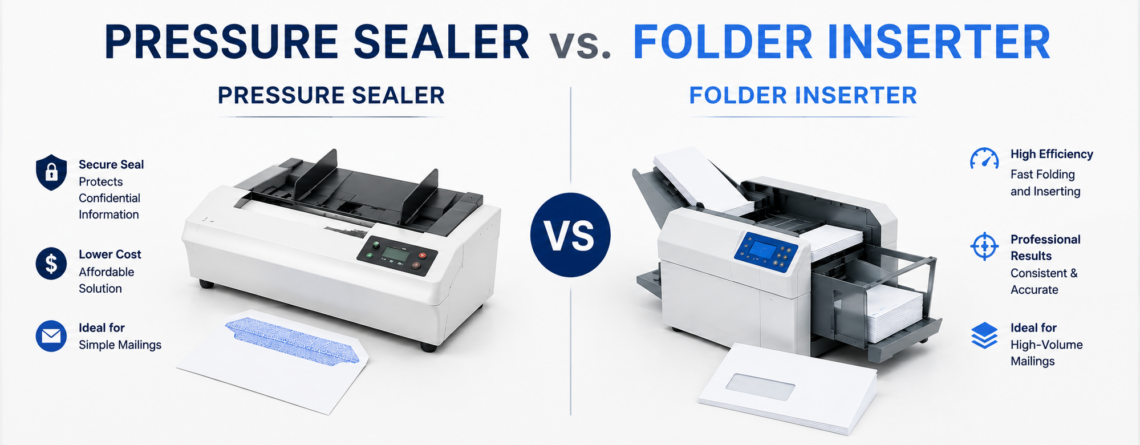
A pressure sealer takes one printed sheet, folds it, and seals its own edges into a finished mailer. No envelope, no inserting.
A folder inserter folds documents and puts them into envelopes, along with anything else that needs to go in the same envelope.
If everything you send fits on one sheet, a pressure sealer is almost always the better machine. The moment you need multiple pages, a return envelope, or a flyer in the same mailing, you need an inserter. Most offices know which of those describes them within about thirty seconds.
How a pressure sealer works
Pressure seal runs on special forms rather than plain paper. The form has a cohesive coating along the edges and fold lines, which does nothing until pressure is applied to it. You print your document onto the form, feed it into the machine, and rollers fold it and press the edges together in a single pass. What comes out is a sealed, tamper-evident mailer ready for postage.
Because there is no envelope and no inserting step, the whole process collapses into one operation. Formax’s mid-volume AutoSeal machines run up to around 100 pieces a minute, and industry figures suggest pressure seal can process substantially more pieces per hour than folder inserters on comparable single-sheet work.
Forms come in standard fold configurations, usually Z, C, uneven Z, and half fold. The fold your document is designed around determines which forms you buy and how the machine is set up, so the form and the machine are chosen together rather than separately.
How a folder inserter works
A folder inserter is the more flexible machine and the more complicated one. It folds your documents, then feeds them into envelopes, and on multi-station models it can add other items to the same envelope from separate feeders.
That flexibility is the whole point. A statement plus a remittance slip plus a return envelope is three separate items going into one outer envelope, and only an inserter can assemble that. It is also what lets you run different jobs on the same machine without changing consumables.
The trade-off is that you are handling more materials, the machine has more to go wrong, and each piece takes longer.
Which one fits your mail
| Your mailing | Better fit |
|---|---|
| Single sheet, same format every time | Pressure sealer |
| Payroll advices and direct deposit notices | Pressure sealer |
| Confidential single-page notices | Pressure sealer |
| Multi-page statements | Folder inserter |
| Anything needing a return envelope | Folder inserter |
| Mailings with a flyer or insert | Folder inserter |
| Varied jobs, different formats week to week | Folder inserter |
| Documents that must look tamper-evident | Pressure sealer |
The cost question, honestly
This is where the comparison usually gets oversimplified in both directions, so it is worth separating the two costs that actually matter.
Consumables. Pressure seal forms cost more per sheet than plain paper, because they are coated. Against that, you buy no envelopes at all. Whether that nets out in your favour depends on the form you use, since a simple one-colour form and a complex pre-printed one are not close in price. The honest answer is that you have to price your specific form against your current paper plus envelope cost. Anyone who quotes you a saving without asking what form you would run is guessing.
Labour. This is usually the larger number and the one offices forget. Pressure seal removes the inserting step entirely, so a job that took an afternoon can take under an hour. If someone in your office currently stuffs envelopes by hand, that time is the real cost you are trying to remove, not the paper.
There is one more factor that only shows up later. Envelopes and inserts mean more consumables to stock, reorder, and run out of at the wrong moment. Single-sheet pressure seal work has one consumable.
Not sure which one your office needs?
Effiservice supplies, installs, and services Formax mailing equipment across Orange County. Tell us what you send, how often, and how many pages each piece runs to, and we will tell you which machine fits, including when the answer is that you do not need one yet.
Prefer to book online? Browse pressure seal solutions and mailing solutions, or contact us here.
Sizing the machine to your volume
Once you know which type you need, the second decision is capacity, and this is where offices most often overbuy.
Pressure sealers
For lower volumes, a tabletop unit is usually enough. Our pressure seal range covers the tabletop AutoSeal FD 2056 through the FD 1406 and FD 1606 where throughput matters more. The practical question is not the machine’s rated speed but how long your longest run takes, because a machine that clears your biggest monthly job in one sitting is sized correctly.
Folder inserters
Inserters are sized by volume and by the number of feed stations, which determines how many separate items you can put in one envelope. The mailing solutions range runs from the low-volume FD 6104 tabletop inserter up through the 6210, 6308, and 6406 Series. If you only ever send one document in one envelope, you do not need a multi-station machine, and paying for feeders you never load is a common and avoidable mistake.
Folding alone
There is a third case worth naming. If your documents are folded and then hand-delivered, filed, or put into envelopes that get sealed some other way, you may only need a folder. A dedicated document folder such as the FD 346 or the fully automatic FD 38Xi does that job faster and for less than either of the other two machines.
What people get wrong
- Buying an inserter for single-sheet work. The most expensive mistake in this category. It costs more to run and takes longer per piece for a job a pressure sealer would clear in a fraction of the time.
- Buying a pressure sealer and then needing a return envelope. A sealed self-mailer has nowhere to put one. If any part of your mail needs a reply envelope, that job cannot go through a pressure sealer.
- Sizing on peak volume rather than typical volume. One heavy month a year does not justify a machine you underuse for the other eleven.
- Ignoring the form design. Pressure seal forms have to be laid out for the fold. A document designed for a standard envelope will not simply drop onto a pressure seal form without rework.
- Forgetting the printer. Both machines take printed output. If your current printer struggles with volume or with the heavier coated stock, that becomes the bottleneck rather than the mailing equipment.
Both, sometimes
Offices with a mix often end up running both, and that is a reasonable outcome rather than a failure to decide.
The usual split is a pressure sealer handling the high-volume repetitive single-sheet work such as payroll and notices, and a smaller inserter for the varied jobs that need envelopes. Because tabletop pressure sealers are the less expensive machine, dedicating one to a single recurring task and keeping the inserter free for everything else is often cheaper than forcing all the work through one larger inserter.
The way to decide is to list what you actually send over a normal quarter, with page counts and frequency, rather than reasoning from the one job that happens to be on your mind. We are happy to go through that list with you.
Servicing and supplies
Both machine types are consumable driven and both have wear parts in the paper path, so neither is a buy-and-forget purchase. Feed rollers, separation components, and sealing rollers all wear with use, and a machine that misfeeds under load stops being used long before it actually fails.
We supply and service Formax mailing equipment throughout Orange County, including Irvine, Anaheim, Santa Ana, Huntington Beach, and Garden Grove, on machines bought from us and elsewhere.
Pressure Sealer vs Folder Inserter FAQ
What is the difference between a pressure sealer and a folder inserter?
A pressure sealer folds a single printed sheet and seals its own edges into a finished mailer, with no envelope involved. A folder inserter folds documents and places them into envelopes, and can add extra items such as return envelopes or flyers to the same envelope. Pressure seal suits single-sheet mail, inserters suit anything multi-part.
Can I use ordinary paper in a pressure sealer?
No. Pressure seal requires forms with a cohesive coating along the edges and fold lines, which bonds to itself when the machine applies pressure. Plain paper has nothing to seal with. The forms come in standard fold configurations, and the fold your document is designed for determines which stock you order.
Which is cheaper to run?
It depends on your form and your labour. Pressure seal forms cost more per sheet than plain paper, but you buy no envelopes and you remove the inserting step entirely. For most offices the labour saving is the larger number. Price your actual form against your current paper plus envelope cost rather than accepting a general figure.
Is pressure seal secure enough for confidential documents?
It is widely used for payroll and other confidential single-sheet mail precisely because the sealed edges are tamper-evident, so interference is visible. Whether it meets a specific compliance requirement depends on that requirement, not on the machine, so check the rule rather than assuming either way.
Can a pressure sealer handle multi-page documents?
Not in the way an inserter can. Pressure seal is a single-sheet process, so a two-page document means two separate mailers. If your documents regularly run to more than one page, or need anything enclosed with them, a folder inserter is the machine you need.
How many feed stations do I need on a folder inserter?
One station per separate item that goes into the envelope. A single document needs one, a statement plus a return envelope needs two, and so on. Paying for stations you never load is one of the more common ways offices overbuy, so count what actually goes in the envelope today.
What if I only need documents folded, not mailed?
Then you probably need a folder rather than either of the other machines. A dedicated document folder does the job faster and for less money. Our range includes the touchscreen FD 346 for desktop volumes and the fully automatic FD 38Xi where throughput matters.
How do I work out what volume machine to buy?
Base it on typical monthly volume and on how long your longest single run takes, not on your busiest month of the year. A machine that clears your largest regular job in one sitting is sized correctly. Sizing on an annual peak usually means paying for capacity that sits idle.
Do these machines need regular servicing?
Yes. Both types are consumable driven and have wear parts in the paper path, including feed rollers, separation components, and sealing rollers. Misfeeds under load are the usual early sign of wear, and they tend to stop a machine being used long before it actually breaks.
Can Effiservice help us choose?
Yes. Tell us what you send, how often, and how many pages each piece runs to, and we will tell you which type fits and roughly what size. We will also tell you when the honest answer is that your volume does not yet justify a machine. Call 714-331-5509 or use our contact page.
